The rooms, photographed 6
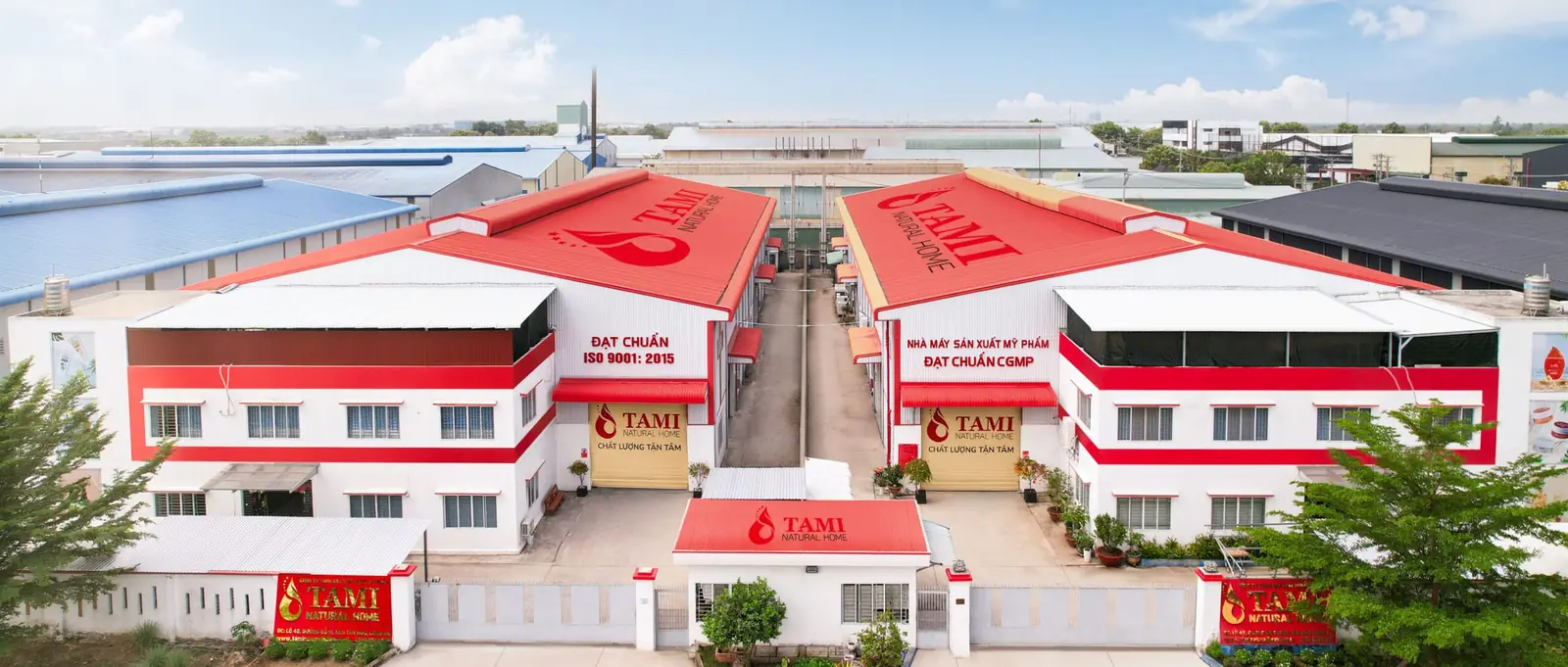


Tan Duc Industrial Park, Tay Ninh Province, Vietnam — 15,000 sqm, 24 production lines, 39 tonnes a day of emulsifying capacity and 14,000 tonnes a year, Formulation, QC and stability testing run in-house. Visits can be arranged at any time; walking the floor against the photographs is the quickest way to check us.
Daily emulsifying capacity of 39 tonnes and annual capacity of 14,000 tonnes are both taken verbatim from the factory's written response of 2026-10-28. We quote them as given and do not convert between them. How many production days a year actually runs depends on the year's schedule; the factory has never put a number on it, and we do not invent one on their behalf.
What you can check yourself is the equipment. The five emulsifying tanks total 14.9 tonnes per batch, so 39 tonnes a day works out at roughly 2.6 batches — a normal scheduling rhythm, not round-the-clock running.
There is also a physical ceiling: the RO water system produces 28 tonnes a day. Any formula containing water — wash products, toners, lotions, shampoo — cannot exceed the water supply.
Put the three together and you can judge which figures to trust. Where you see a three-digit daily output quoted elsewhere, run the same arithmetic. We do not quote one, because it does not survive the sum.
Warehousing deserves its own note. Some raw materials and packaging are imported and carry long lead times; 5,000-plus square metres of storage buffers exactly that, so you are not forced to hold a full run of material on your own books.
The plant, the emulsifying rooms, the filling station, the QC laboratory and the warehouse are the ones in the photographs below — walk them against the images when you visit: the aerial is this site, the tank sizes are the ones listed, the tank-room flooring and ceiling are built to CGMP workshop standards, and the filling and QC frames are those two rooms.
Bring this list when you visit and check it item by item: site area, number of production lines, daily emulsifying capacity, main tank sizes, warehouse zoning, and how workshop temperature and humidity are controlled. Where something does not match, ask on the spot.
Send the dates and how many people are coming and we arrange the visit. It is fine to visit before discussing an order — confirming the lines fit your category is more useful than arguing price first.
Customer audits and third-party audits usually work from the same list: legal entity, certificates, production and QC records, warehouse zoning, and facility and hygiene controls. We prepare against that list rather than assembling documents once an audit is booked.
Available on the spot: business licence and tax code (1101978460); the original certificates for CGMP-ASEAN (912/GCN-QLD, renewal in progress) and ISO 9001:2015 (749435, valid to 2027-08-17); batch-traceable production and QC records; zoning and temperature/humidity records for the raw-material and packaging stores; and output records for the 28 tonnes/day RO water system.
What we cannot provide, stated up front: we do not hold BSCI or Sedex, and we have no third-party social-compliance audit report. If either is on your checklist we mark it "not held" — we do not substitute another certificate for it. It is written here so you know the gap before you take this to an internal review.
The same checklist expanded into a printable piece — with twelve questions for the day and the four most common traps — is on auditing a Vietnamese cosmetics factory.
Every position photographed above can be walked to: the site, the emulsifying room, the packaging store, the warehouse, the raw-material store and the finished-goods store. You see production as it is running, not a staged sample room.
Three things are not open: formulations other clients are currently running, other clients' packaging and artwork, and the supplier labels on incoming materials. Not secrecy — that information belongs to other customers.
There is now a 60-second film shot on the floor, on the process page: nine locations cut in production order, with no voiceover, no music and no text on the frame. It is still an edit, so we do not present it as live — if you want to see the lines, see them on site. The tour route does not pass through the offices, dormitories or canteen, which is why there are no photographs of them here.
You get three answers back: whether it is feasible, the MOQ, and how sampling works. If it does not fit our lines, we say so in the first email instead of the third meeting.